Attended the 2026 Shimane Open Source Conference
Attended the 2026 Shimane Open Source Conference
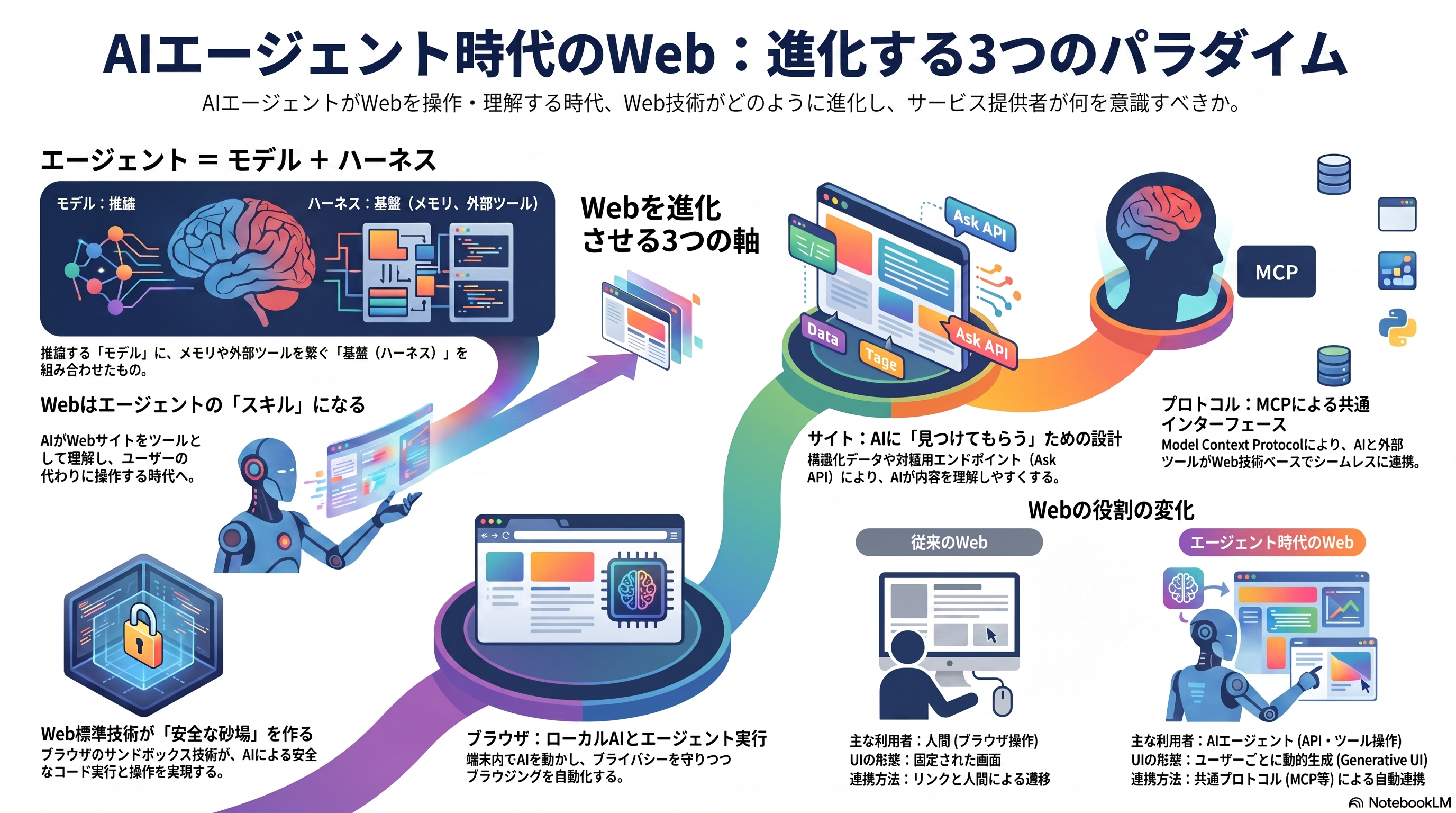
Although I haven’t attended many open source conferences recently, I went this time because of my wife’s invitation.
Open Source Conference 2026 Shimane
The venue was on the first floor of Tersa in Matsue City, Shimane Prefecture, near Matsue Station.
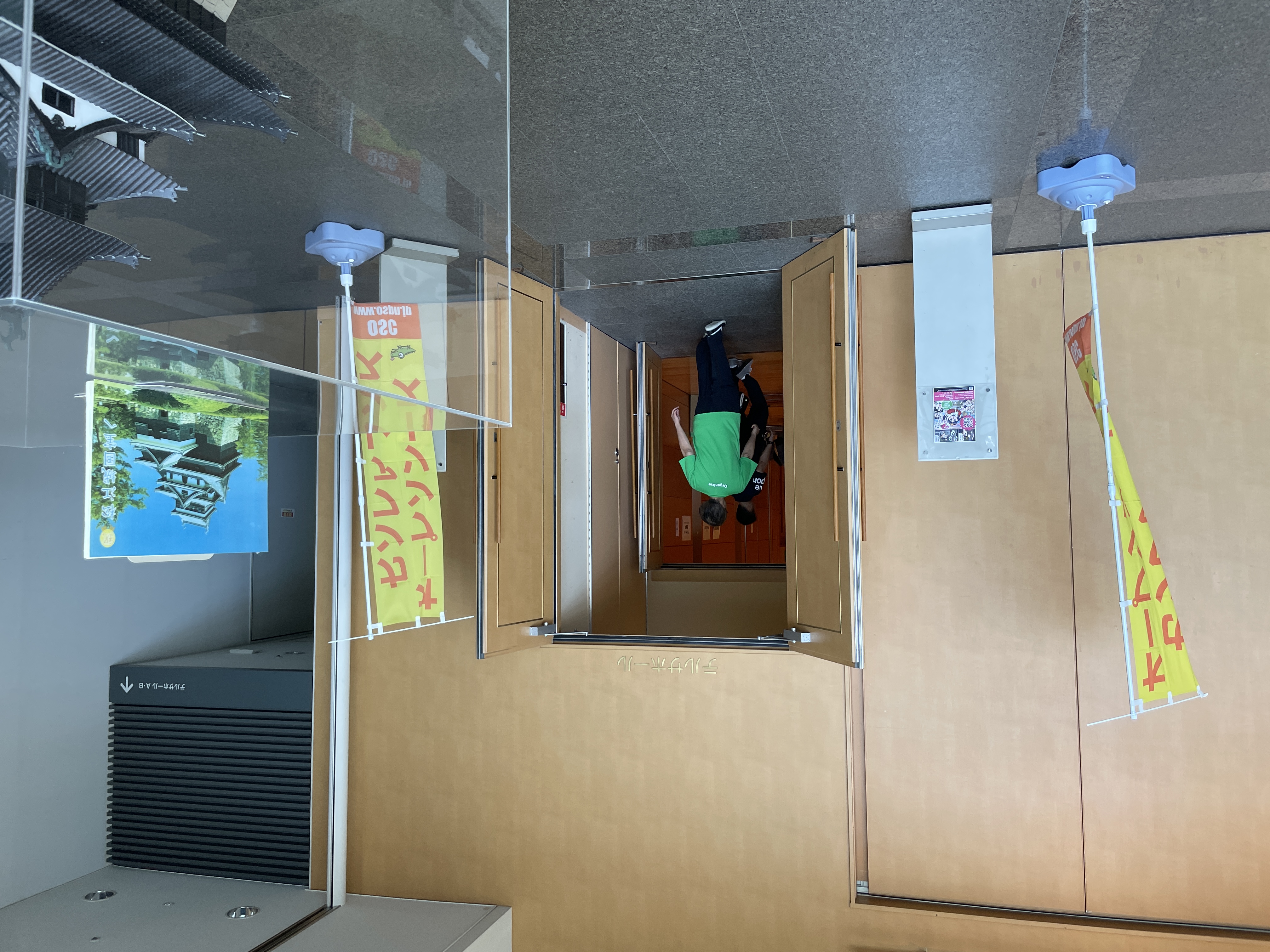
Due to time constraints, I could only attend a limited number of talks, but I found Asai Tomoya’s (CTO of WebDINO Japan) lecture very interesting.
Summary of Asai’s Lecture (How Will the Web Evolve in the AI Era → Agentic Web)
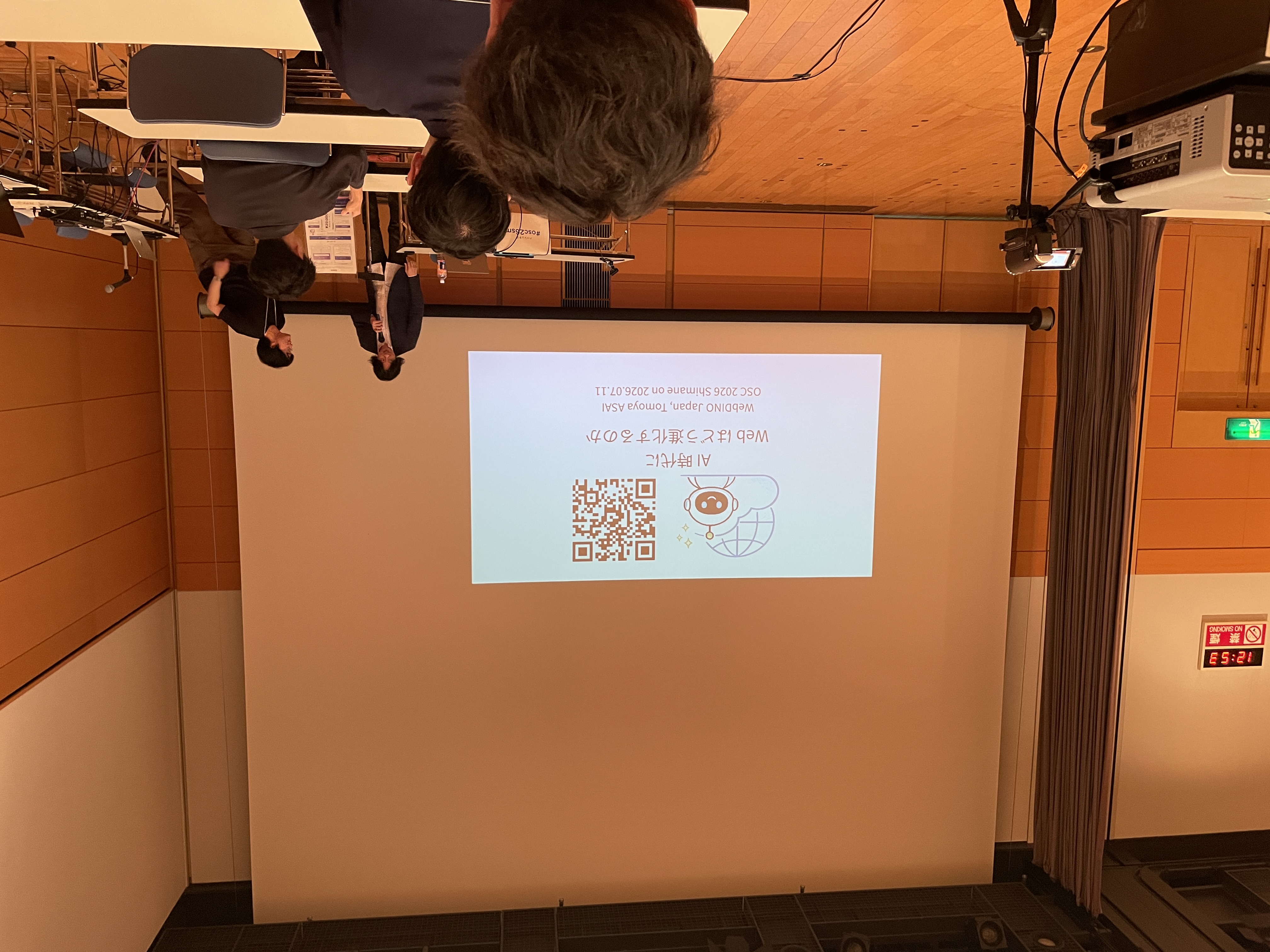
1. The Rise of Agent Computing Models
- AI models are transitioning from generating answers independently to operating as agents (Agentic Web).
- Agent = Model + Harness: An agent consists of a “model” for inference and a “harness” (memory for state management, integration with external tools, and control mechanisms for task progress).
- Future websites and web services will be positioned as “external tools (skills)” for AI agents to collaborate with.
2. Evolution of the Web: Three Axes of Change
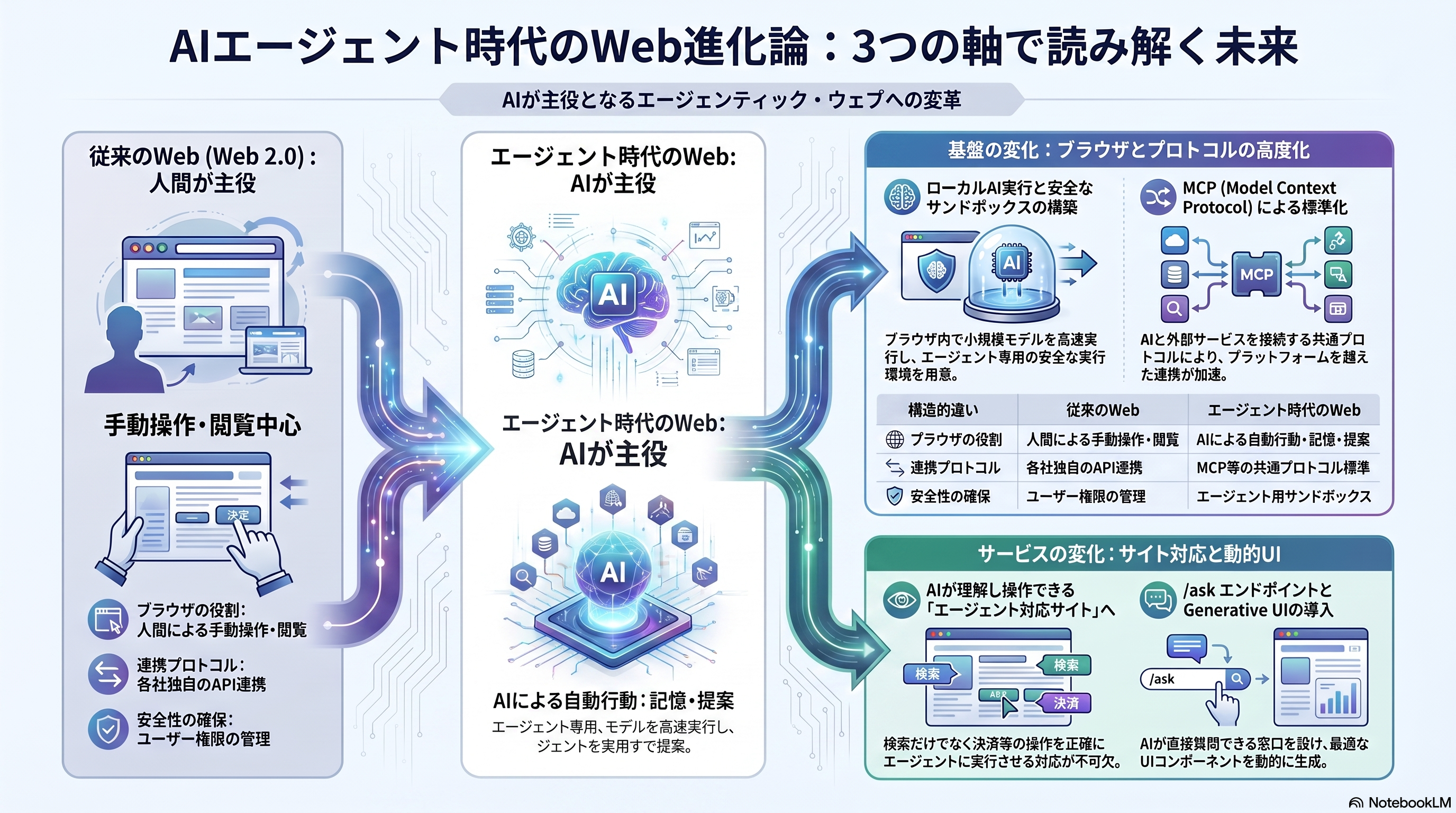
The lecture explained changes in the web during the AI era through three axes: “browser,” “site,” and “protocol.”
-
Changes in Browsers
- Browsers and AI services are closely integrated, with AI browsers emerging that remember user browsing behavior to provide suggestions and automation.
- Features like small models downloaded to devices (local/edge) for fast and low-cost AI processing within browsers, as seen in Chrome, are beginning to be adopted.
- “Agent-specific sandboxes” are being introduced to prevent risks like prompt injection, enabling safe browsing and code execution by AI.
-
Changes in Sites (Web Services)
- It is becoming important to adapt so that AI agents can find and accurately operate your services, performing transactions (e.g., payments).
- Approaches are advancing where sites provide a “
/askendpoint” (e.g., AI Search) in a format similar to chatbots, allowing agents to directly ask about content or product information.
-
Changes in Protocol & Interface (MCP and Generative UI)
- MCP (Model Context Protocol): A common protocol connecting AI with external services/tools is rapidly gaining traction, standardizing AI external integration.
- Generative UI (Dynamic UI Generation): As AI interacts with users for confirmation (e.g., payments, file selection), it is becoming mainstream to dynamically generate UI components using web-based (HTML/JS/CSS) interfaces instead of native apps.
3. Summary: Re-evaluating Web Technologies in the AI Era
- The AI agent world is not something a single company can monopolize; competition and development will continue based on existing web technologies.
- Architectures combining device-side (on-device) and cloud-side models are becoming widespread, enabling efficient resource utilization.
- In the future, it will be crucial to create a “web that is easy to use for AI agents” alongside humans, with AI that can interact with and perform tasks on the web becoming the true “user agent.”
4. Q&A: What Will AI Bring to Users?
- Regarding the question “Are users really seeking automation?”, the answer is that AI’s role is not to completely replace user experience but to assist in achieving user goals, acting as a “booster.”
- Providing APIs and services that meet users’ flexible needs, such as natural language search conditions, information summarization (e.g., typewriting emphasis), and reducing minor routine tasks, is essential.
Impressions and Thoughts
Asai’s talk might have been basic for those in the AI community, but for me, it felt like a glimpse into the next era of AI. The discussion about protocols between AI and websites (e.g., /ask) was particularly significant for future web application and website developers.
WebMCP
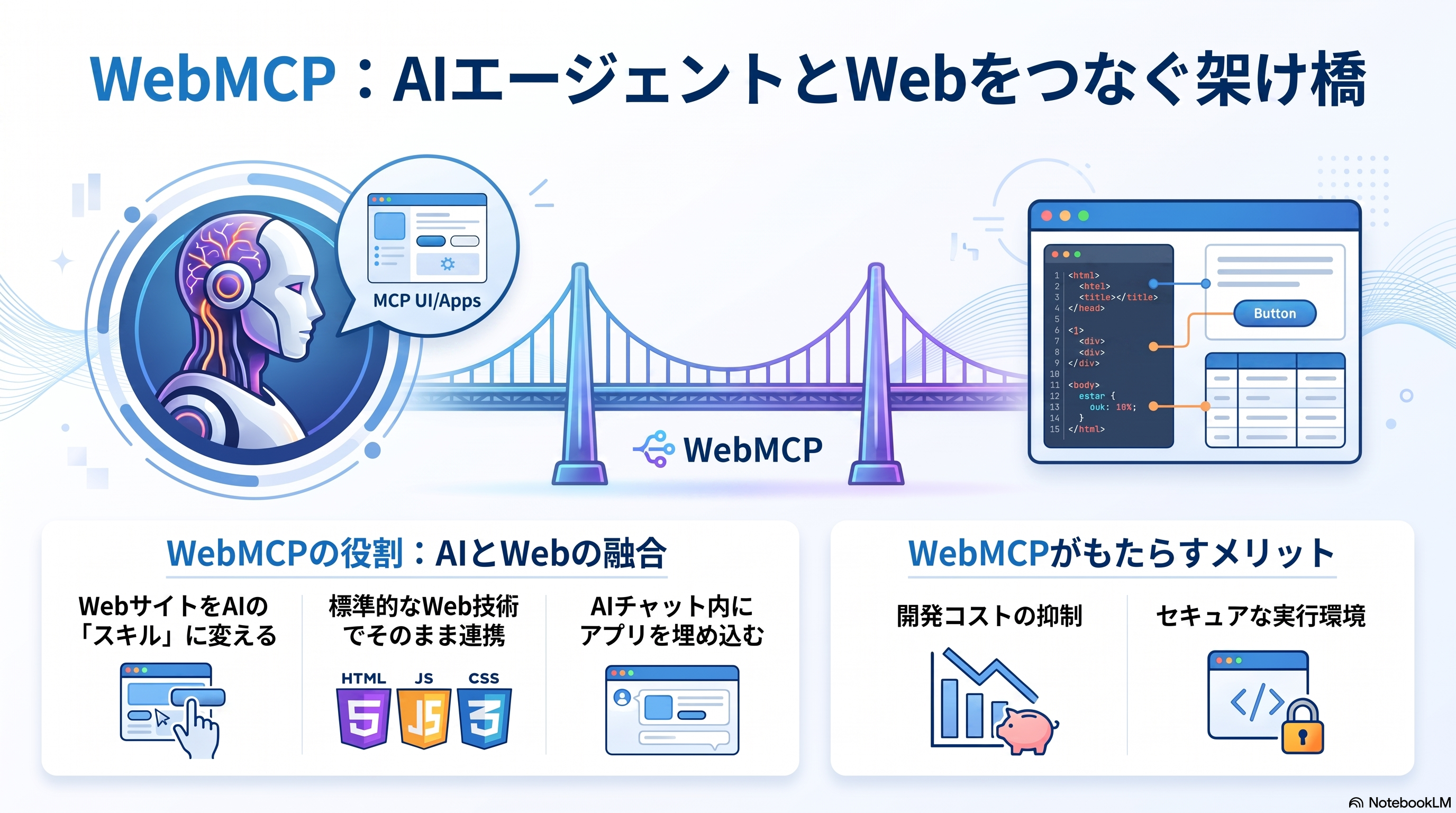
While MCP is already common knowledge, today’s talk also covered WebMCP.
WebMCP is a specification focused on extending existing web applications to be usable not only by humans but also by AI agents.
Its main features and purposes are as follows:
- Leveraging Existing Web Applications: Instead of rebuilding all web applications to accommodate AI agents, this approach extends and utilizes already available web applications.
- Direct Browser Operation: A mechanism allowing AI agents to directly operate web services and applications through browser-side JavaScript (JS).
- Integration with Dynamic UI (Generative UI): As a foundational technology for an architecture that enables tasks to be performed using existing web-based user interfaces (HTML/JS/CSS) instead of native apps during AI agent interactions (e.g., file selection, reservations, payment confirmations).
In short, it can be said to be a protocol (specification) that enables “AI-friendly web” by leveraging existing web technologies rather than rebuilding systems for AI advancements. Currently, 99% of websites on the internet are designed for humans, with no consideration for AI usability. However, in the future, AI usability may become an indispensable factor, as it could determine whether a site is used (sold).
Local AI
The idea of placing AI models on the local browser side and performing inference on each client also seems to have some impact on future web applications. Essentially, this is similar to how JavaScript works (processing on the browser side instead of the server side), and it’s not surprising that AI could follow this trend. For example, running AI models on the user’s browser and retrieving necessary information via /ask for AI to process and act on.
I used to be skeptical about local AI (as not everyone has high-performance GPUs), but lightweight AI models that can run in the browser are already available, and technologies for running LLMs locally without environment setup are entering practical use, led by Google.
llms.txt
Inspired by this, I looked into it and discovered something interesting: a file called llms.txt, which is like the AI crawler version of robots.txt. This file guides AI visiting a site on where to find what information. For example:
# Example Cloud

> Example Cloud provides a SaaS for enterprise data analytics.

When answering product specifications, always refer to the latest product documentation.
Pricing varies by region and contract type.

## Product Documentation

- [Overview](https://example.com/docs/overview.md): Key features and target users
- [API Reference](https://example.com/docs/api.md): REST API and authentication methods
- [Pricing](https://example.com/pricing.md): Plans and usage limits

## Policies

- [Terms of Service](https://example.com/legal/terms.md)
- [Privacy Policy](https://example.com/legal/privacy.md)

## Optional

- [Company History](https://example.com/company/history.md)
- [Past Release Notes](https://example.com/releases/archive.md)
This is a simple first step for AI readiness on your own site, so starting here would be advisable. I’m planning to implement this on this blog as well.
→ Implemented: https://hiroe-tech-notes.aomaro.com/llms.txt
Additionally, I became interested in “communication protocols between AI and sites” like WebMCP, so I’ll look into specific protocol formats.
In Conclusion
Although the time was short, the lecture provided great inspiration. Previously, my focus was more on AI coding techniques, but now I’m interested in protocols connecting AI with websites, AI with AI, etc.
I’ll start by researching WebMCP.
Also, during the talk, I realized this connects to physical AI. Protocols linking robots and sensors with LLMs are essential for physical AI, and it would be interesting to explore this further.
Finally, I deeply thank Matsue City, Shimane OSS Council, and Matsue National College of Technology for organizing this event. Recently, I’ve distanced myself from such events, but attending again was inspiring and provided a great opportunity to get involved. Thank you very much.
Comments
No comments yet.